
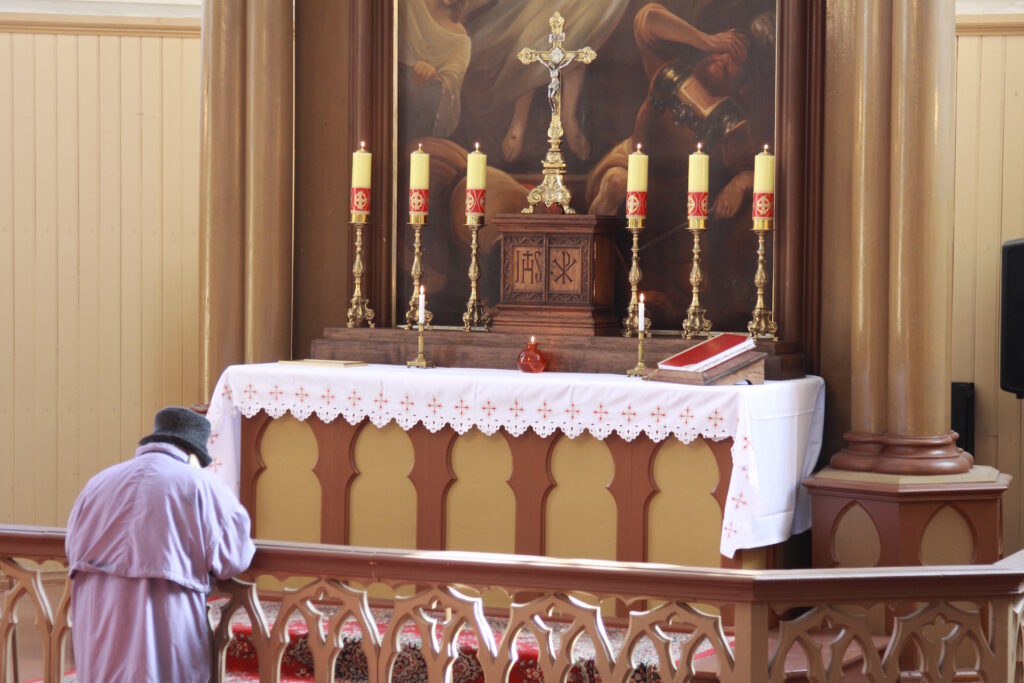
What does it mean to be a member of the congregation?
One becomes a Christian in baptism and grows as a Christian by trusting God in the fellowship of the congregation. Prayer, participation in worship, and service to one’s neighbour belong to Christian life.
Confirmation affirms the baptised as full members of the Church. Read more about confirmation.
As a member of the congregation, you have the right to
- receive Holy Communion; a baptised child may receive Communion under the care of a parent or guardian, in agreement with a member of clergy, if the child has been taught to understand the meaning of Communion;
- make confession;
- receive pastoral rites, such as marriage, anointing of the sick, blessing of the home, and funeral rites;
- have your children baptised and serve as a godparent;
- ask for the congregation’s intercessory prayer in worship or privately;
- invite a member of clergy to visit you if you feel the need and cannot come to church yourself;
- ask the congregation for material assistance;
- vote and stand for election to the governing bodies of the congregation and the Church as a whole;
- be buried with a church funeral and share in the promise of eternal life.
As a member of the congregation, you are called to
- live as a disciple of Jesus Christ and a child of God;
- take part in Sunday Masses and major church festivals;
- pray for the congregation, its members and clergy, and for all people;
- support your neighbours spiritually and, when necessary, materially;
- support the work of God’s kingdom with a donation according to your means. Some give a tithe, that is, 10% of their income; others give another amount that is right for them. (See also: Donate!)
How should I participate in worship?
- Please come on time whenever possible. Those who arrive late are welcome too; if you need to move about during the service or leave early, do so quietly and, whenever possible, during a congregational hymn, not during a prayer.
- Turn off your mobile phone or set it to silent mode. Ask permission before taking photographs.
- Dress respectfully and comfortably. Men remove their hats in church.
- Take a hymnbook or song sheet from the entrance. The order of service is in the Mass leaflet; return the hymnbook after the service.
- During prayers, the song of praise, the Gospel reading, the Creed, the Eucharistic liturgy, and the blessing, the congregation normally stands. You may also kneel during confession and the consecration of the Eucharist.
- Confirmed church members and the baptised children who are with them, and who have been taught to understand the nature of Communion, receive Holy Communion. If you would like a blessing, come to the altar with the others and place your right hand on your chest.
- If you would like intercessory prayer or someone to be remembered, speak with a member of clergy or the parish office before the service. For a longer conversation, arrange a time with a member of clergy during the week.
- At a concert, applause is appropriate at the end of the whole programme; there is no applause after a prayer, church hymn, or devotional song.
- Children are welcome in church. It is the parents’ task to help them learn how to behave in church.
Prayer and fellowship in the congregation
Prayer, such as morning, evening, and meal prayers, together with the habit of taking part in worship, is important in the life of every Christian. View the most important prayers.
Membership under church law
Membership of the Church begins in baptism: the members of the EELC are those received into the Church through baptism or in another manner described in the Church Statutes (Constitution, põhikiri, § 7). Every member also belongs to one congregation — the one in which they were baptised, or the one into which the pastor has received them upon their application (Constitution § 8). Membership is evidenced by the entry in the congregation’s register of baptisms; if there is no such entry, by a certificate of baptism or another document attesting to it (Church Statutes, kirikuseadustik, § 40).
A child under 15 is baptised with the consent of the parents or guardian, and the parents decide which congregation the child belongs to. From the age of 15 a person decides for themselves which EELC congregation they belong to (Church Statutes § 39 and § 45).
Full membership begins with confirmation: the right to share in services and church rites and to take part in the life of the Church belongs to a baptised and confirmed member. The same provision states the corresponding duty — to live a Christian life in accordance with the promises made at baptism and confirmation, to share in the Word and the sacrament, and to fulfil one’s obligations towards the congregation, including supporting its work materially or by voluntary work (Church Statutes § 43; Constitution § 7¹).
The general assembly, voting and standing for election
The governing bodies of a congregation are the general assembly (täiskogu), the council and the board (Constitution § 49). The general assembly comprises all confirmed members of the congregation who, in the previous or current calendar year, have received Holy Communion and paid the membership fee or made a membership donation, and whose rights have not been restricted under church discipline (Constitution § 51).
In elections to the congregation’s council, a confirmed member who is at least 18 years old and meets these same conditions may vote and stand as a candidate (Church Statutes § 203 and § 208). The council is elected for four years, and it in turn elects the board (Constitution § 54 and § 57). The current members of the council and the board are listed on the Contact page.
The list of members of the general assembly is drawn up no later than four weeks before the election, and every member of the congregation has the right to examine it. If the congregation has no record of your receiving Communion, your oral or written confirmation is enough for you to be entered on the list. If you have not been entered on it, you may submit a complaint to the board (Church Statutes § 212).
The membership donation
Under church law, supporting the congregation is not a matter of free choice but a duty of membership: a member supports the congregation’s work materially or by voluntary work (Constitution § 7¹(2)). In our congregation the recommended membership donation is at least 1% of income; many give a tithe (10%) or another amount they consider suitable. Having paid it in the previous or current calendar year is also a precondition for belonging to the general assembly and for the right to vote. (See Donate!)
Moving to another congregation, leaving and returning
- To another EELC congregation: submit a written application to the pastor of the congregation you wish to join; the pastor decides within one month of receiving the letter of transfer (Church Statutes § 46).
- A rite in another congregation — confirmation, a wedding or the baptism of a child — may be performed there once the letter of transfer has been received (Church Statutes § 47).
- Coming from another church: submit a written application; where necessary this is preceded by a confirmation course or an introduction to EELC doctrine and church order (Church Statutes § 41).
- Leaving the EELC: a member notifies the pastor of the congregation in writing (Constitution § 9).
- Returning: submit an application to the pastor of the congregation you wish to join; membership is restored by the entry in the congregation’s register of members (Church Statutes § 42).
This section is based on the Constitution of the EELC (2023) and the Church Statutes of the EELC (2026), both available in Estonian only. In case of doubt, the wording of those documents prevails over this summary.