Holy Mass, a service with Holy Communion
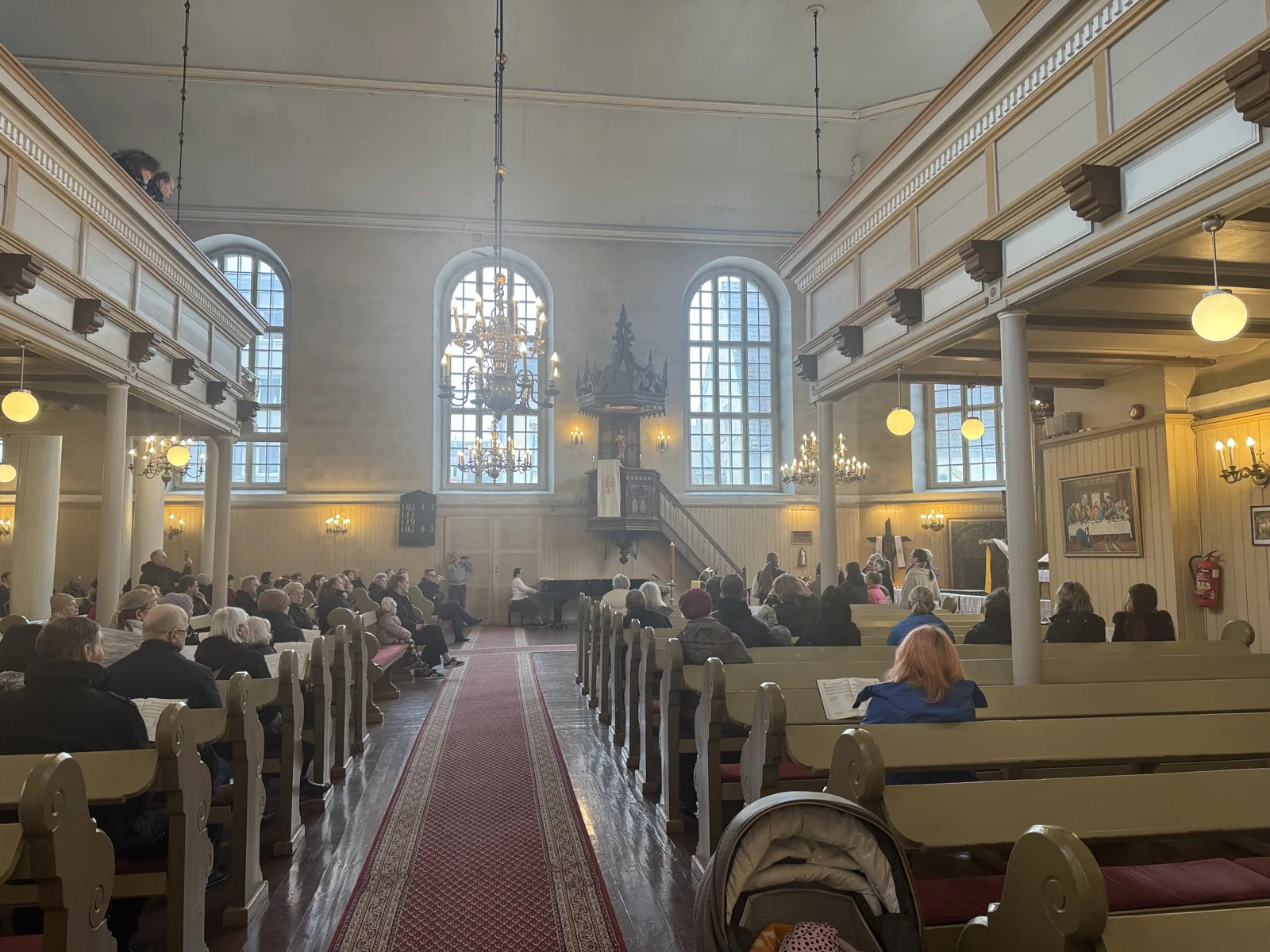
Holy Mass is celebrated in the church every Sunday at 10.00. Welcome!
If you would like to make your confession before Mass, please arrange it with the parish pastor.
What does Holy Mass mean?
Mass — this short word means the same as a phrase five times longer: a service with Holy Communion.
If you would like a short summary of what the Church teaches about Holy Communion, click here.
The word liturgy comes from the Greek leitourgia, which means service. Divine service, liturgy and Mass all mean one and the same thing.
In the ancient world, leitourgia meant an action through which a group of people became “one body” — something more than they would have been as a mere sum of individuals. It also meant a person or a group acting at their own expense for the common good of the community.
In this sense, the liturgy of the people of Israel was to prepare the world for the coming of the Messiah. The Church herself is likewise liturgy: a calling to act in this world in the mind of Christ and to bear witness to Him and His Kingdom.
All people are called to serve God. This happens through love and good works. God is loved and served by serving and loving our fellow human beings. At Holy Mass, however, God is served with an inward love directed upwards and with a thankful heart for what God has done for us. The service is also called the Eucharist, the sacrifice of thanksgiving — a word that can denote both Holy Communion and the whole Mass.
From the very beginning, Christianity has been the proclamation of joy. The Good News begins with the words of the angel: “Behold, I bring you good news of great joy that will be for all the people!” (Luke 2:10) and ends with the words: “And they worshipped him and returned to Jerusalem with great joy.” (Luke 24:52) The Eucharist — joyful thanksgiving — is the sacrament of this joy, and it finds its clearest expression in the Sunday service.
The beginning of Mass
The greeting
In truth, the service begins already with leaving home. When people rise on Sunday morning and set out — whether they drive twenty kilometres to church or walk two blocks — they leave their everyday life behind for a moment, and the congregation of this particular Sunday is already being formed. Until now they were separate individuals, each with their own cares and joys; now they are called together to become more than they were on their own.
Even the decision to dress differently from every day — festively — and to set aside other pleasant activities for the sake of taking part in the service is in itself already a form of worship: a small sacrifice and preparation that attunes us to the meeting with God.
Holy Mass usually begins with a hymn of the congregation, which is praise and thanksgiving to God. The minister then begins the service in the name of the Father and of the Son and of the Holy Spirit, and greets the congregation.
Beginning the service — and likewise ending it — in the name of the Father and of the Son and of the Holy Spirit reminds us that we are not here on business of our own, nor have we gathered on our own initiative: we have been called and authorised.
When a judge in a courtroom pronounces a judgment in the name of the Republic of Estonia, this carries quite a different weight from the words of one private person or another. In the same way, a service held in the name of the triune God is something quite other than a friendly gathering of people.
Here we have the official embassy of God’s kingdom on planet Earth.
At the words “in the name of the Father and of the Son and of the Holy Spirit” the minister and the congregation bless themselves with the sign of the cross.
The sign of the cross
A great deal of communication between people is wordless. Body language — handshakes and gestures, postures, facial expressions and the like — carries messages and shapes the mood. Blessing oneself with the sign of the cross, both priest and congregation, is just such a wordless prayer.
As Luther recommends it in his catechism for daily prayer, so our order of Mass recommends it at the beginning and at the end of the service. “Far be it from me to boast except in the cross of our Lord Jesus Christ, by which the world has been crucified to me, and I to the world.” (Galatians 6:14)
Let us use symbols clearly and boldly: let the sign of the cross be visible and evident, reminding everyone that we worship and honour the triune God — the Father, who is above all; the Son, who has come down from heaven and become man; and the Holy Spirit, who unites us with God and with one another.
Amen
The congregation answers the minister’s words with its own “Amen”. In the Judaeo-Christian tradition “Amen” is the equivalent of a signature in one’s own hand, that is, an expression of assent. The Hebrew word amen means “truly, certain, so be it, so it is”.
We are bearers of that same tradition of the people of God which reaches back to the days of the Old Testament. With its “Amen”, then, the congregation confirms that it is of one mind and consents to take part in the service of the triune God.
The congregation’s “Amen” is at the same time a response to God’s call to communion and unity. When the priest declares in whose name we have gathered here, the whole congregation answers “Amen”, expressing its readiness to enter into that communion.
In a liturgical service it also matters that this is not a one-man show but the common service of the whole congregation. In the liturgy the priest does not speak alone, but in the name of the congregation. The “Amen” is the voice of the congregation, by which it makes the priest’s words its own.
The Lord be with you
The greeting “The Lord be with you”, together with the congregation’s response “And with your spirit”, is not simply “welcome to the service”: it is a prayer in dialogue. It creates unity between the congregation and the priest, marks the transitions between the parts of the Mass, and recalls the presence of Christ — the priest, greeting the congregation with open hands, represents Christ, on whose palms the name of the congregation is inscribed by the marks of the nails (cf. Isaiah 49:16).
The repetition of the greeting during the Mass is therefore not accidental, but reflects the step-by-step structure of the service. (Historically, the confession of sin was an act that preceded the Mass.) The Mass is not the minister’s solo performance, but a dialogue between God and his people.
As with much else in the liturgy, this dialogue too has a biblical origin. The greeting comes from the Old Testament — And behold, Boaz came from Bethlehem and said to the reapers, “The Lord be with you!” And they answered, “The Lord bless you!” (Ruth 2:4; cf. also 2 Corinthians 13:11) — and from the letters of the apostles (e.g. 2 Timothy 4:22). It expresses God’s presence among his people.
The early Christian tradition rests on this foundation: the greeting is known to have been used already in the fourth century at the transitions between the parts of the Mass.
Instead of “The Lord be with you”, the apostolic greeting may also be used: “The grace of the Lord Jesus Christ, the love of God and the fellowship of the Holy Spirit be with you all.” (2 Corinthians 13:13; 13:14 in some English Bibles). When a bishop presides, he may also greet the congregation with the words of the risen Christ: “Peace be with you.” (John 20:26)
And with your spirit
The congregation’s response is likewise of biblical origin: “The grace of our Lord Jesus Christ be with your spirit, brothers. Amen.” (Galatians 6:18; the same wording also in Philippians 4:23 and Philemon 25) and “The Lord be with your spirit. Grace be with you.” (2 Timothy 4:22)
The confession of sin
Trusting in God’s mercy, we have the opportunity to confess our failings and sins. “For,” as St John writes, “if we confess our sins, he is faithful and just, and will forgive us our sins and cleanse us from all unrighteousness.” (1 John 1:9)
By the main door of the church, together with the hymnals, you will find the order of service, which contains two texts for the confession of sin. We use the longer one in Lent and the shorter one at other times.
Kyrie
The confession is followed by the cry of prayer “Kyrie eleison!” — “Lord, have mercy”. This is one of the oldest and most enduring parts of the Mass in the Western Church. Its origin lies at least in the fourth and fifth centuries, and when Latin became predominant in the West, the Kyrie remained the only Greek part of the liturgy. That it has survived is a beautiful sign of the catholicity, the all-embracing nature, of the Church (as is the use of the equally foreign word “Amen”).
“Kyrie eleison” is not merely a plea for help; it is also a confession that God is merciful.
In the ancient world such a cry was also an acclamation addressed to a ruler or a higher authority: this was how the emperor was greeted in the Roman Empire when he entered a temple or the circus. Christians took over the formula, confessing that the true Ruler is Jesus Christ, who is met in the divine service.
Biblical background
The prayer “have mercy” (“eleison”) occurs often in the Gospels, where people cry out to Jesus: “Son of David, have mercy on me!” (Matthew 9:27; Luke 18:38).
- Two blind men near Jericho, on the road to Jerusalem, cry out: “Lord, Son of David, have mercy on us!” (Matthew 20:30–31) — in Greek Κύριε, ἐλέησον ἡμᾶς (Kyrie eleēson hēmas), exactly the formula later used in church.
- The prayer of the Canaanite woman: “Have mercy on me, Lord, Son of David!” (Matthew 15:22) — again Κύριε … ἐλέησόν με.
- The prayer of the ten lepers: “Jesus, Master, have mercy on us!” (Luke 17:13) — in Greek Ἰησοῦ ἐπιστάτα, ἐλέησον ἡμᾶς.
In the Old Testament, too, the prayer “have mercy” (in Hebrew חָנַן / ḥanan and רַחַם / raḥam) occurs hundreds of times, especially in the psalms: “Have mercy on me, O God, according to your steadfast love” (Psalm 51:1), “Have mercy upon us, O Lord, have mercy upon us” (Psalm 123:3). In the Greek translation, the Septuagint, these passages often read ἐλέησον.
Jesus himself teaches us to ask for mercy: the tax collector’s prayer “God, be merciful to me, a sinner!” (Luke 18:13; in Greek Ὁ θεός, ἱλάσθητί μοι τῷ ἁμαρτωλῷ) is the spiritual heart of the Kyrie.
Gloria and Laudamus
The congregation then sings the Gloria to the praise of God: the song of the angels from the Gospel according to St Luke: “Glory to God in the highest, and on earth peace, good will among people.” (Luke 2:14) The invitation to give glory to God is connected not so much with the preceding confession as with the whole of the service, in which God touches us.
Christianity is a religion of the incarnation: the Word becomes flesh, heaven touches earth, and this is why we sing at the beginning of Mass the angels’ song of Christmas night — the feast of the incarnation. Praise is the response befitting the creature to the grace of God that calls to us.
The Gloria is not sung in Lent, and it is customarily omitted in Advent as well.
On great feasts the Laudamus is sung after the angels’ song to the praise of God — a hymn known from at least the fourth century, whose refrain “We praise you, we glorify you, we worship you” the congregation sings with. On ordinary Sundays, hymn no. 1 of the Estonian Hymnal (“Au, kiitus olgu igavest”) or another hymn suitable for the praise of the triune God is sung instead.
The collect of the day
The collect of the day is again preceded by the dialogue “The Lord be with you”. It is also known as the collecta, because it gathers up the theme of the whole of the present service.
The collect has a five-part structure:
- the address to God;
- a relative clause referring to some attribute or deed of God;
- the petition;
- the clause of purpose;
- the closing doxology.
For example: God, source of all light, (1) Simeon and Anna were given to see your Son in the temple and to praise you for the Saviour of the world. (2) Guide us also by your Spirit, (3) that we may recognise the salvation you have prepared for Israel and for all peoples in Jesus Christ, our Lord, (4) who with you, in the unity of the Holy Spirit, lives and reigns for ever and ever. (5)
The Liturgy of the Word
The Word of God
The next part of the Mass is called the Liturgy of the Word: here we read and listen to what God wishes to say to his congregation through the Scriptures. Normally three passages are read from the Bible: the first from a book of the Old Testament, the second from the letters of the apostles in the New Testament (epistle = letter), and the third from one of the Gospels.
Between the readings the congregation may again sing thanks to God, usually with a psalm (a spiritual song) from the Old Testament, the refrain of which is sung by the whole congregation and the verses by the cantor or the choir.
The reading of Scripture has been part of the service from the very beginning. Justin Martyr (c. 100–165) describes this part of the early Christian liturgy as follows:
“On the day named after the sun, all who live in a city or in the countryside gather together, and the memoirs of the apostles and the writings of the prophets are read for as long as time permits. When the reader has finished, the president admonishes and exhorts us in a sermon to follow these good teachings. Then we all rise together and offer prayers …”
The sermon
On the basis of the readings a sermon is preached, which sums up and expresses in language intelligible to people today what God wishes to say through those readings.
The sermon is usually followed by a couple of minutes of silence or a piece of music, during which each worshipper can reflect on what has been heard.
The Creed
Then comes the congregation’s common response to the Word of God — the solemn confession of faith, the Credo.
At services the Nicene Creed is used, and at baptisms the Apostles’ Creed. You can read both on the page Christian Creeds.
The Liturgy of the Faithful
The prayer of the Church
After the Creed the intercessions are brought before God — the congregation prays for the whole world, for all people and for itself. Christians have been given a great privilege: they need not be afraid before God, but have with him the relationship of a child to its father, and may come before him with their prayer at any time, also on behalf of those who do not have such a close relationship with God.
The offering and the preparation for Communion
The intercessions are followed by the collection, with which the congregation supports the work of its church and parish. At the same time the altar is prepared for Holy Communion: the bread and wine are brought to it, over which the priest says the prayer over the gifts in the name of the congregation.
In former times there are said to have been two processions at the celebration of Communion, instead of the one we have today — the coming forward to receive Communion.
During the first, people brought forward their gifts; of these, part of the bread, water and wine was taken for the consecration of Communion, part remained for the love feast, and part was afterwards distributed to the poor.
In this way every Christian could clearly and visibly share with their gifts in the common service — even a poor person who had nothing to bring but water. God accepted these gifts and made of them his wondrous feast of joy, the sacrament of Christ’s Body and Blood.
The two processions brought out clearly the twofold movement of the Christian life: giving — the offering of ourselves and of our gifts into God’s service — and receiving, for from him we receive everything back a hundredfold and in a new quality. Above all we are called to give God ourselves — and he gives us himself in return.
Today this is replaced by taking the collection and preparing the gifts for Communion, which are bought with the money given in the collection or placed in the offering box. They are still our own gifts, which are now brought before God with prayer, so that he may make of them something still more wonderful.
In bringing our gifts together we also express unity: we are working towards a common goal and are devoted to the building up of that same Body whose head is Christ.
Sanctus and Benedictus
After the dialogue “The Lord be with you” that opens the celebration of Communion, the minister invites the congregation to lift up their hearts to the Lord — that is, to set aside earthly thoughts and to turn their attention upwards to God. The congregation answers: “We lift them up unto the Lord.” The minister then invites us to give thanks unto the Lord our God, and the congregation answers: “It is meet and right so to do.”
The minister now prays the preface, which leads into the hymn of praise “Holy, holy, holy”, sung “with angels and all the company of heaven” and known by its Latin name Sanctus.
The Sanctus is the song of the angels from the heavenly service, which we now enter. The prophet Isaiah tells:
“In the year that King Uzziah died I saw the Lord sitting upon a throne, high and lifted up, and the hem of his robe filled the temple. Above him stood the seraphim; each had six wings: with two he covered his face, with two he covered his feet, and with two he flew.
And one called to another and said: “Holy, holy, holy is the Lord of hosts; the whole earth is full of his glory!” And the foundations of the thresholds shook at the voice of him who called, and the house was filled with smoke.” (Isaiah 6:1–4)
The early Christians understood that in order to become a temple of the Holy Spirit they had to ascend in worship to heaven, where Christ has gone — and that precisely this is the condition and source of all their service in the world.
We then greet with the cry of Hosanna Christ, who in the sacrament comes bodily near to his people. Hosanna was in Judaism a cry of greeting addressed to a king. The Gospel of Matthew tells: And the crowds that went before him and that followed him shouted, “Hosanna to the Son of David! Blessed is he who comes in the name of the Lord!
Hosanna in the highest!” (Matthew 21:9) It is from these words — benedictus qui venit, “blessed is he who comes” — that the second part of the hymn takes its name, Benedictus.
We do the very same now, when Christ comes bodily into our midst in Holy Communion.
Holy Communion
Now the service reaches its summit — the Most Holy Sacrament of the Altar, or Holy Communion. Holy Mass is a meeting of God and human beings, and Holy Communion is the high point of that meeting. It has been prepared for by the confession of sins and forgiveness, by prayer and song, by hearing God’s Word and by confessing our faith.
Now comes the moment when God and human beings may be in true communion — this is why receiving the sacrament is called Holy Communion. Holiness and reverence belong inseparably to Holy Communion.
It was in the breaking of the bread that the disciples on the road to Emmaus recognised the risen Christ (Luke 24:30–31). We too meet the risen Lord in Holy Communion.
Before the sacrament is distributed, the peace is exchanged. It is introduced by a dialogue between the minister and the congregation.
The kiss of peace, from which today’s greeting of peace derives, was in use already in the oldest Christian liturgies. Behind it stand the words of the Saviour: “So if you are offering your gift at the altar and there remember that your brother has something against you, leave your gift there before the altar and go; first be reconciled to your brother, and then come and offer your gift.” (Matthew 5:23–24)
Holy Communion is a meal in which, receiving bread and wine, we share in the Body and Blood of Christ, standing at the same time as it were on Mount Calvary beneath the Lord’s cross and taking part in his redeeming sacrifice. How this is to be understood becomes clear in what follows.
Christ, the Lamb of God
There was a time in the history of Israel when the people lived in slavery in Egypt. Pharaoh — the king of Egypt — would not let the Israelites leave his land, and so the Egyptians were struck by a series of disasters. The last, the tenth, was this: in one night all the firstborn of the Egyptians were to die.
So that this plague would not strike the Israelites, every family killed a lamb and marked the doorposts with its blood. Thus the blood of that lamb saved the people from death and brought them freedom from slavery. In memory of this event the Jews keep a great feast every year, called the Passover — and the lamb killed on that occasion was called the Passover lamb.
St Paul writes that Jesus Christ is the new and true Passover Lamb (1 Corinthians 5:7), who died in order to save the whole of humanity from death, perdition and slavery to sin. It is his Body and Blood that set people free from death and sin and bring them eternal life.
Before receiving Holy Communion the congregation turns to Christ as the Lamb of God, asking him for forgiveness and peace: “Agnus Dei, qui tollis peccata mundi …” — “Lamb of God, you take away the sins of the world …”
Receiving bread and wine at Holy Communion, the Church believes, according to Jesus’ promise, that it thus shares in the Body and Blood of Christ and so, through participation in his sacrifice on the cross, also in the forgiveness of sins and eternal life.
“For,” as St Paul writes, “the Lord Jesus on the night when he was betrayed took bread, and when he had given thanks, he broke it and said, “This is my body, which is for you. Do this in remembrance of me.” In the same way also he took the cup, after supper, saying, “This cup is the new covenant in my blood.
Do this, as often as you drink it, in remembrance of me.”” (1 Corinthians 11:23–25)
This is why Holy Communion is so important and so essential: in the Most Holy Sacrament of the Altar we are given what people need most of all; and since Jesus Christ is the only way to God, communion with him through his Body and Blood is also the most direct and the closest communion with God that is possible in this world and in this life.
Holy Communion is the Lord’s Supper — eating at the same table with the Lord expresses the deepest and most perfect belonging of Christians to him. In the same way Holy Communion also signifies the belonging together of all who share in it — and not only with fellow members of one’s own parish, but with all Christians throughout the world, including those who have already departed this life.
St Paul writes: “The cup of blessing that we bless, is it not a participation in the blood of Christ? The bread that we break, is it not a participation in the body of Christ?
Because there is one bread, we who are many are one body, for we all partake of the one bread.” (1 Corinthians 10:16–17) A very ancient Christian prayer runs: “As this broken bread was scattered upon the mountains and was gathered together and became one, so may your Church be gathered together from the ends of the earth into your kingdom.” (Didache 9:4)
Because Holy Communion is a sign of the unity of all Christians, it is received by those who are baptised. Every Christian who is not knowingly and deliberately persisting in unrepented sin may always receive Holy Communion when taking part in the service.
The prayer of thanksgiving
Communion may again be followed by silence for reflection, for recollection and for prayer.
“O give thanks unto the Lord, for he is good, alleluia,” the minister calls to the congregation after the celebration of Communion, and the congregation answers: “And his mercy endures for ever. Alleluia.”
This has been the sigh of the people of God since the days of the Old Testament: “O give thanks unto the Lord, for he is good, for his mercy endures for ever!” occurs in the same words at least nine times in the Old Testament.
There follows the closing prayer, the post communionem, in use since the fourth century. In it the priest gives thanks to God in the name of the whole congregation for the Communion received; it is at the same time the closing prayer of the service.
The blessing
After the thanksgiving the minister blesses the congregation with two blessings. First he speaks the words of the Aaronic blessing, and then blesses the congregation in the name of the Father and of the Son and of the Holy Spirit. This is a priestly blessing, whose roots lie on the one hand in the Old Testament and on the other in the Christian doctrine of the Trinity.
The Lord spoke to Moses, saying: “Speak to Aaron and his sons, saying: Thus you shall bless the people of Israel; you shall say to them:
The Lord bless you and keep you!
The Lord make his face to shine upon you and be gracious to you!
The Lord lift up his countenance upon you and give you peace!
So shall they put my name upon the people of Israel, and I will bless them.” (Numbers 6:22–27)
Blessing in the name of the triune God is a specifically Christian blessing, and it binds the service into a whole, reminding us that, like the common liturgy of the congregation, so also the daily divine service of every Christian (cf. Romans 12:1) is instituted and willed by God himself.
Announcements and the sending
After the blessing and the closing hymn, brief announcements are made about the events to come, and the congregation is sent out into the world to love and to serve God and neighbour.
The words of sending — “Go in peace and serve the Lord with joy!” — are not merely the conclusion of the service but the beginning of the Church’s mission.
When the early Christians returned from worship to the world, their faces reflected the joy and light of the Kingdom of God. They brought with them no programmes or theories, but wherever they went, the seeds of God’s Kingdom sprang up, faith was kindled and lives were changed. When they were asked where the source of this power lay, they knew what to answer and where to lead people.
In conclusion
Holy Mass is a meeting between a human being and God. At the service people serve God with their thanksgiving and love, and God serves people by forgiving them, by speaking with them, and by calling and receiving them into communion with himself in the Most Holy Sacrament of the Altar.
Holy Mass is a feast of joy; it is time given to people so that they may step out of the cares and troubles of the world. It is a time in which they are given strength to step back into the midst of the world and to carry on the love received from God — by serving their fellow human beings and doing them good.
God is always and everywhere with us, but Holy Mass is an opportunity to feel his presence directly and undisturbed, and to experience full communion with him.
The meaning of worship is to become one — to become the Body of Christ, the Church. It is in the Sunday assembly and in the Eucharist that the congregation becomes what it truly is: the Body of Christ, the temple of the Holy Spirit, a visible sign of God’s Kingdom in this world.
The Orthodox theologian Alexander Schmemann has said that joy cannot be analysed or defined — joy is entered into: “Enter into the joy of your Lord!” (Matthew 25:21) That is why the end of the Mass is always also a beginning: from here we are sent into the world, so that things which seemed impossible may become possible.
Order of worship
Service booklet
Masses at St Elizabeth’s Church follow the order authorised by the Estonian Evangelical Lutheran Church. The service booklets are available in the church by the main door, together with the hymnals. The same material can be read on your own device as an Estonian-language PDF.