Anyone wishing to join the confirmation course is welcome to Holy Mass in the church on Sundays at 10:00, followed by coffee in the confirmation hall. Please speak to either of the parish clergy there.
You do not need to be baptised or already certain that you wish to join the parish. You are also very welcome simply to come and listen.
Welcome!
Confirmation marks a person’s spiritual coming of age: they publicly affirm the Christian principles of faith and ethics and undertake to live by them.
Throughout the Christian world, confirmation is regarded as one of the most important and solemn events in a person’s life.
If you wish to attend confirmation classes
Please contact the parish pastor, Toomas Nigola, on +372 516 4158 or at toomas.nigola@eelk.ee.
What is confirmation?
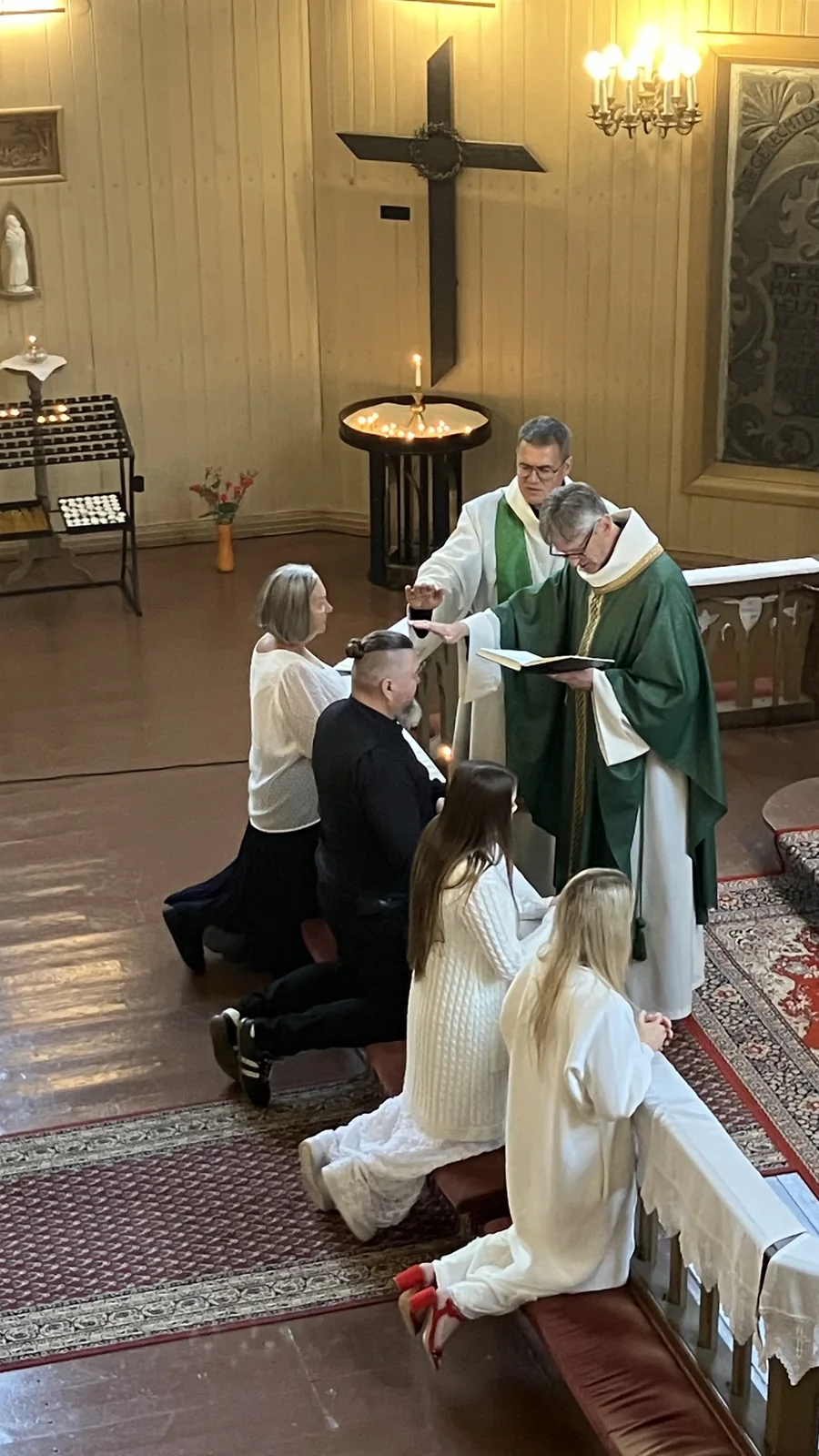
In confirmation, a person baptised as a child is received as a full member of the Church. An adult who has not yet been baptised is baptised in connection with confirmation.
The Latin word confirmare means “to strengthen” or “to confirm”. In the rite, the candidate affirms the Christian faith and the desire to live as a Christian in this life and for eternity. Having established that the candidate has received instruction in the faith, the minister in turn confirms their membership in the Church.
Confirmation presupposes instruction. This follows from the missionary command given by the Lord to his disciples:
Jesus came and said to them, “All authority in heaven and on earth has been given to me. Go therefore and make disciples of all nations, baptising them in the name of the Father and of the Son and of the Holy Spirit, and teaching them to obey everything that I have commanded you. And remember, I am with you always, to the end of the age.” (Matthew 28:18–20)
What is taught in confirmation classes?
Instruction covers at least the main parts of the Catechism—the Ten Commandments, the Creed, the Lord’s Prayer and teaching on the sacraments—together with Bible stories, especially the life of Jesus, the order of worship, important hymns, and the organisation of the Church, including the rights and duties of a parish member.
Confirmation instruction is normally given in a course. Courses also address the Christian worldview, church history, practical ethical questions and the life of the local parish. Exceptionally, and by agreement with a pastor, instruction may be completed independently with suitable reading.
What does confirmation give?
In confirmation the baptised person enters the full communion of faith of the Church, the Body of Christ, and receives the gift of the Holy Spirit to bear witness to Christ in word and deed.
Confirmation gives a member of the Church spiritual and organisational rights and duties:
- the right to receive Holy Communion independently (a baptised child may receive under the care of a parent or guardian, by agreement with the pastor);
- the right to make confession;
- the right to receive the rites of the Church, including marriage, anointing of the sick, blessing of a home and a Christian funeral;
- the right and duty to have one’s children baptised;
- the right to serve as a godparent;
- the right to request the parish’s intercessions, publicly or privately;
- the right to ask a minister to visit when needed and one cannot come to church;
- the right to request material assistance from the parish;
- the right to vote and stand for election to parish and wider Church governing bodies;
- the right to a Christian funeral and the promise of eternal life with the Church triumphant;
- the duty to live a holy life as a disciple of Jesus Christ and a child of God;
- the duty to attend Holy Mass on Sundays and major feast days;
- the duty to pray for the parish, its members and clergy, and for all people;
- the duty to support one’s neighbours spiritually and, when needed, materially;
- the duty to give a tithe—ten per cent of one’s income—or another appropriate amount for the work of God’s kingdom.
A practical overview can be found on the page Life as a Member of the Congregation.
Confirmation is therefore a great privilege and also a responsibility. If a confirmed person neglects these duties, the Church may later restrict their rights. Active participation in parish life, however, provides support and strength for Christian living.
Who may attend confirmation classes?
In earlier times confirmation was chiefly for young people and marked their entry into adult life. In Estonia today it is preparation for joining the parish and can be undertaken at any age. Many participants come later in life, when they have more time and desire to reflect on life and eternity.
No prior knowledge is required, nor must a participant already regard themselves as a convinced believer. What matters is sincere interest and a willingness to attend classes and worship, read, reflect and discover.
Those who have doubts about aspects of Christianity are equally welcome. Each person makes their own final decision about joining the parish, at the latest on the morning of confirmation. Honest doubt is part of human life. Christian faith is not blind obedience to propositions but a continuing journey towards truth and clarity. At the same time, the course is more than general education: participants also learn to pray, trust God and show serving love to others in Christ’s example.
When should I be confirmed?
The traditional age is between 15 and 21, but willingness and readiness to learn matter more than age. A person baptised as a child who has not been confirmed by the end of their twenty-first year is removed from the parish membership register and is restored through confirmation. Those not yet baptised are also welcome: the course then prepares them for Baptism as well.
There is no upper age limit. You may always join a course or speak to one of the parish clergy.
Who confirms, and into which parish?
Instruction and confirmation are administered by a minister: a bishop or a priest authorised by the bishop. The pastor is also the member’s spiritual adviser and support.
The confirmed person’s details are entered in the records of the local parish, which maintains their membership and family record. They are therefore a member both of the Estonian Evangelical Lutheran Church and of the local parish, Pärnu St Elizabeth’s Parish.
For further information about confirmation courses, contact Pastor Toomas Nigola on +372 516 4158 or at toomas.nigola@eelk.ee.