St Nicholas’ Parish in Pärnu is part of the history of St Elizabeth’s Parish. As its legal successor, St Elizabeth’s Parish also preserves the heritage of Pärnu’s former German town parish. For centuries St Nicholas’ Church was the central place of worship in the townscape of Pärnu. The work of its clergy was connected with parish life, with schools and with the culture of the town.
In 1924 the large St Elizabeth’s Parish was divided into two pastoral districts, each with its own pastor. In 1935 these became separate parishes, St Elizabeth’s First and Second Parish; the pastor of the Second Parish was August Arumäe.[1]
Nikolai and Niguliste are two Estonian forms of the same patron saint’s name. In historical sources Nikolai kogudus (St Nicholas’ Parish) usually refers to the German congregation; the name Niguliste kogudus was given in 1940 to St Elizabeth’s Second Parish. The church decisions described below explain how these stories are connected.
From medieval town church to Lutheran parish
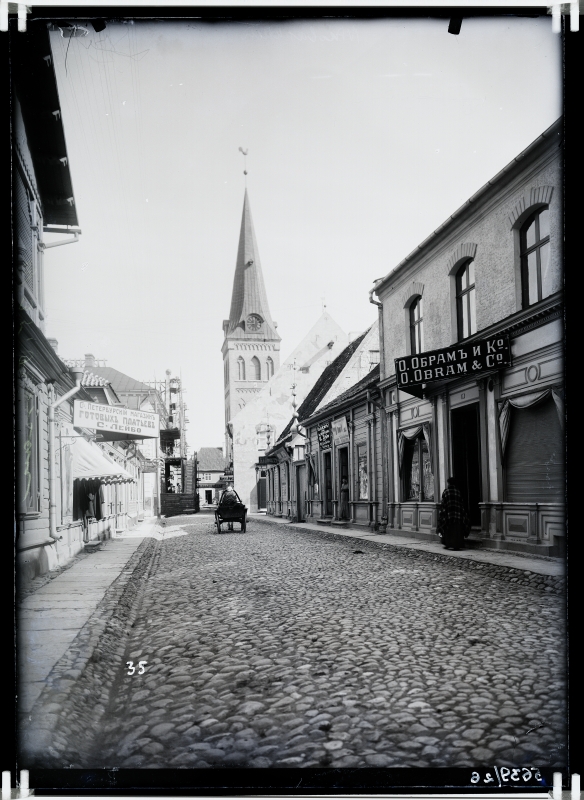

The beginnings of St Nicholas’ Church go back to medieval New Pärnu. The first church was built in the 13th century and was enlarged in the following centuries. The patron of this merchant town’s church was St Nicholas, protector of seafarers and merchants. The church stood near the town hall, at the corner of Pikk and Nikolai streets.[2][3]
The church was damaged in the fires of 1513 and 1524. The Reformation reached Pärnu in the 1520s, and in 1526 there was also an outbreak of iconoclasm. Under Polish rule St Nicholas’ Church was handed back to the Catholics, and St John’s Church was built for the Lutherans. When Swedish rule was restored, St Nicholas’ Church returned to the Lutheran congregation. After repairs the church was reconsecrated on 12 July 1649.[2]
In the 17th century the church received an organ built by master Christoph Memmken and bells donated by Queen Christina of Sweden. The tall spire was completed in 1683. The tower burned in 1771 and was damaged again by lightning in 1885. Both times the church was restored, so its outward appearance changed repeatedly over the centuries.[2]
A shared history with St Elizabeth’s Parish
The histories of the German and Estonian Lutheran congregations of Pärnu are closely intertwined. When St John’s Church was taken over by the garrison in 1714, the Estonian congregation also held its services in St Nicholas’ Church. The Estonian congregation’s new St Elizabeth’s Church was consecrated in 1750. For some time, therefore, St Nicholas’ was the shared church of both congregations.[3]
St Nicholas’ Parish served mainly the German-speaking townspeople of Pärnu. In the 19th century Latvian-language services were also held in the church. Ministry to different language groups explains why the sources name senior pastors, deacons and Latvian preachers at the same time. The registers of the Latvian congregation are preserved as a separate fonds in the National Archives of Estonia.[3][4]
Clergy of St Nicholas’ Parish
Information about the earlier clergy is fragmentary. Sources from the 16th and 17th centuries name, among others, Andreas Hermann, Martin Westphal, Johann Schwanning, Friedrich Löwenstein, Johann Jacob Segius and Johann Vestring. From the early 18th century Nicolaus Bergius and Jacob Andreas Zimmermann are known. On the basis of current information they cannot all be placed in an unbroken succession.[5]
The following overview distinguishes between senior pastors and assistant clergy. The beginning and end of a term of office may differ between reference works. The 18th-century terms are given here according to Heinrich Laakmann’s study, which is based on the parish registers.[6]
- Johann Ludwig Voit (1731–1743; 1743–1747). First deacon, then senior pastor.
- Georg Matthäus Schnetter (1747–1767). Senior pastor.
- Wilhelm Scipio (1769–1786). Senior pastor; the burial registers he kept also contain longer biographical notes.
- Johann Karl Theodor Stein (1786–1807). Senior pastor.
- Christian Gottlieb Mayer (1807–1810). Senior pastor; in 1810 he continued his ministry at St Olaf’s Parish in Tallinn.
- Karl Heinrich Wolleydt (1810–1845). Senior pastor; left office on 28 June 1845.[5]
- Johann Heinrich Märtens (deacon from 1835; senior pastor 1845–1854). Installed as senior pastor in the autumn of 1845; also worked as a teacher in Pärnu.[5]
- Heinrich Otto Reinhold Girgensohn (1851–1854; 1854–1881). First deacon, then senior pastor. From 1881 to 1888 he was General Superintendent of Livonia.
- Ferdinand Karl Julius Kolbe (1881–1910). Senior pastor; also involved in the school life and German societies of Pärnu.
During Wolleydt’s long term of office the deacons of the parish were Nathanael Bahrt (1787–1811), Johann Friedrich Wilhelm Morr (1814–1817), Ferdinand Keilmann (1818–1819) and Conrad Eduard Hesse (1823–1834). Johann Heinrich Märtens began as deacon in 1835 and succeeded Wolleydt as senior pastor. Keussler’s supplementary volume of 1877 dates his installation to the autumn of 1845; Napiersky’s earlier lists give 1846 as the starting year.[5]
The 19th-century information in this overview is based on clergy reference works and biographical studies.[5][7][8][9]
Assistant clergy and ministry to the Latvian congregation. Alexander Gustav Jungmeister was deacon of St Nicholas’ Parish from 1846 to 1851. Liborius Gustav Wilhelm Krüger served as deacon from 1854 to 1861 and was also connected with the Latvian congregation. Friedrich August Scheinpflug was the Latvian preacher and religion teacher in Pärnu from 1861 to 1902. Woldemar Paul Sielmann served as deacon from 1902 to 1906.[5][10][11]
Heinrich Girgensohn (1825–1888) served in Pärnu for three decades. Besides his parish work he taught at the girls’ school and took part in the work of the Livonian Consistory. His later office as General Superintendent of Livonia links the history of St Nicholas’ Parish with the church life of the whole region.[8]
Ferdinand Kolbe (1847–1910) had served in Nizhny Novgorod before coming to Pärnu. He became senior pastor of St Nicholas’ Parish in 1881. From 1881 to 1891 he was also inspector of the town’s higher girls’ school and served on the town school board. His long term of office included the tower fire of 1885 and the restoration of the church.[9]
Clergy in the 20th century
Emil Bielenstein — senior pastor 1910–1920
Emil Bielenstein came to Pärnu from Courland. He had previously been pastor of Sahten (Zante) and director of the private German gymnasium in Libau (Liepāja). He served St Nicholas’ Parish during the First World War and the years of Estonia’s independence. After leaving Pärnu he was pastor of Polle in Germany from 1920 to 1928.[11]
Wilhelm Eugen Leonhard Kentmann — senior pastor 1920–1934
Wilhelm Kentmann (1861–1938) had served at Kullamaa and at St Peter’s in St Petersburg and had been General Superintendent of Estonia before coming to Pärnu. Alongside St Nicholas’ Parish he taught religion at the private German gymnasium in Pärnu and led the charitable society Vaestesõbrad (“Friends of the Poor”). His work brought together church, school and social welfare.[12]
Waldemar Karl Thomson — assistant pastor 1925–1934, pastor 1934–1939
Waldemar Thomson (1897–1945) was the last pastor of St Nicholas’ Parish before the resettlement of the Baltic Germans. He also taught religion at the German school in Pärnu and in 1938–1939 was dean of the German deanery of the Estonian Evangelical Lutheran Church (EELC). In 1939 he left Estonia and then served St Luke’s Parish in Poznań. He died in February 1945.[12]
Nikolai and Niguliste: the changes of 1940
The departure of the Baltic Germans in 1939 changed the situation of St Nicholas’ Parish fundamentally. Newspaper reports in January 1940 still described the union of St Elizabeth’s Second Parish with St Nicholas’ Parish as a plan; a survey in April already spoke of it as accomplished. The parish was served by August Arumäe, pastor of St Elizabeth’s Second Parish.[2][13]
Two separate church decisions were made on 28 August 1940. By a decision of the EELC Consistory the former St Nicholas’ Parish in Pärnu was dissolved. On the same day the Consistory changed the name of EELC Pärnu St Elizabeth’s Second Parish: its new name became EELC Pärnu Niguliste Parish. These decisions should not be understood simply as a renaming of the German parish: they concerned two different parish bodies. Both decisions were published in Kiriku Teataja on 17 September 1940.[14]
Services were held in St Nicholas’ Church also in 1940–1941. In 1940 St Elizabeth’s Second Parish began to use the old St Nicholas’ Church for its services. For example, Pärnu Päevaleht of 30 June 1940 announced a service with Holy Communion in St Nicholas’ Church for that day. The church remained in use under the name of Niguliste Parish: Uus Elu of 25 October 1941 announced a service in Niguliste Church for the following day, with Pastor P. Särgava named as preacher.[15]
August Arumäe — pastor of Niguliste Parish 1940–1941
August Arumäe (1895–1976) was pastor of St Elizabeth’s second pastoral district from 1925 and of St Elizabeth’s Second Parish from 1935, and dean of Pärnu from 1930. His ministry continued in the parish that received the name Niguliste in 1940. In 1941 he was arrested and deported to Siberia; he was able to return to Estonia in 1958. His life is described in more detail on the page on the clergy of St Elizabeth’s Parish.[3]
Destruction of the church and the later fate of the parish
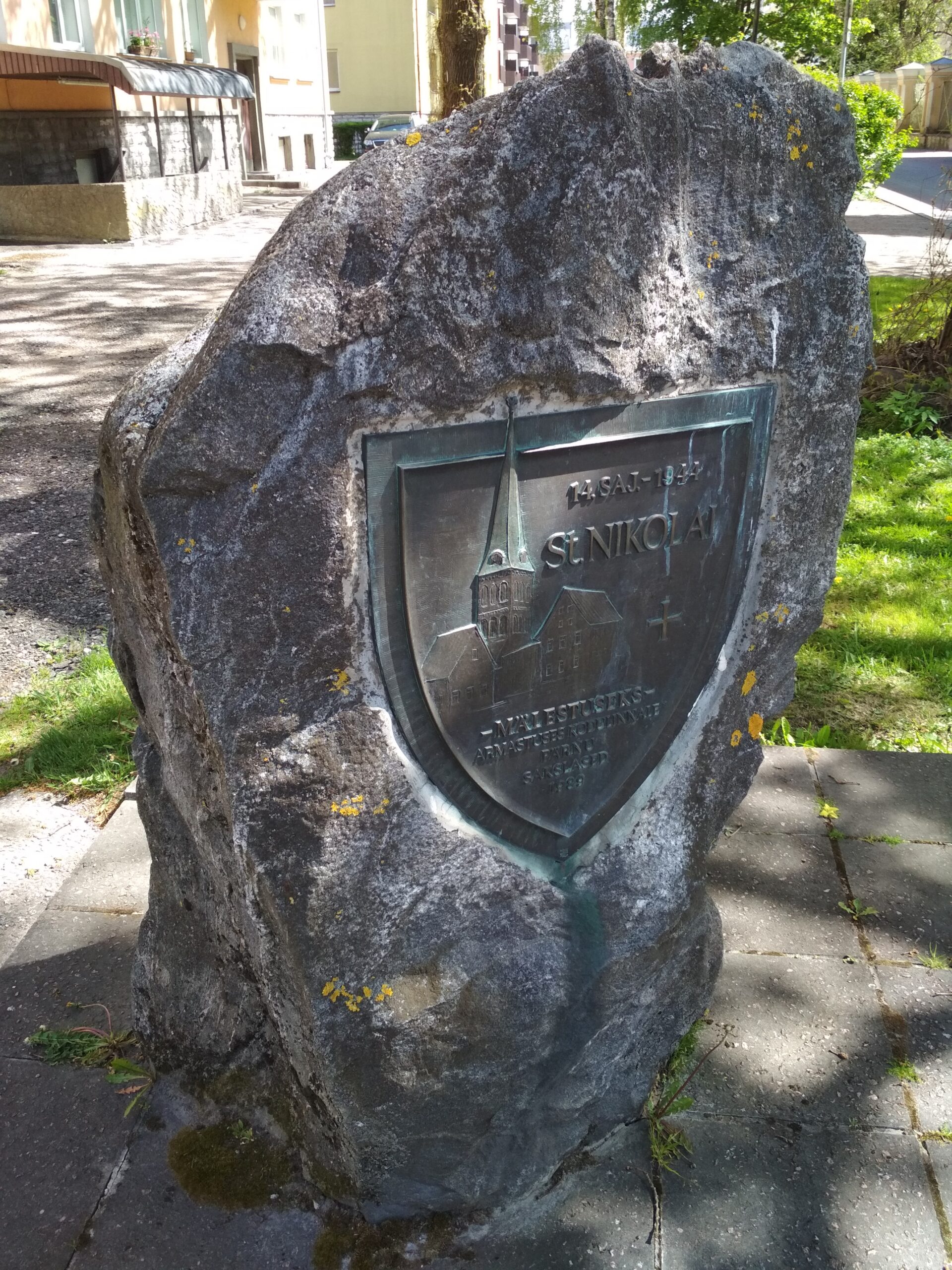

St Nicholas’ Church burned during the fighting in September 1944. The church was not rebuilt, and the ruins were demolished in 1954. A memorial stone unveiled in 1989 marks the former site of the church near the town hall.[3]
After the war the Soviet authorities restricted the activity of parishes through registration. In 1945 registration was refused to Pärnu Niguliste Parish, which had neither its own church nor its own pastor. Riho Altnurme’s study discusses it together with other town parishes in the same situation. This meant that Niguliste Parish could not continue as an independent parish in its former form.[16]
The history of St Elizabeth’s Parish thus includes traces of Estonian as well as German and Latvian parish life. The disappearance of St Nicholas’ Church from the townscape has not erased the story of its parish. It is kept alive by parish registers, old photographs, the biographies of the clergy and the memory of the church’s site.
Sources and further research
This page brings together verified historical and biographical information, but it is not a complete list of clergy from the Middle Ages onwards. Details of earlier terms of office and of post-war parish continuity can be clarified with documents in the National Archives of Estonia and the EELC archive.
- Kristjan Luhamets. „Koguduse lugu: Pärnu Eliisabeti kogudus”. e-Kirik, 18.11.2021: division of the parish into two pastoral districts in 1924. Kiriku Teataja, 06.09.1935, p. 8: Consistory decision of 11 July 1935 establishing St Elizabeth’s First and Second Parish.
- E. G. Bliebernicht. „Nikolai kirik — Pärnu vanim pühakoda”. Uus Elu / Pärnu Uudised, 17.04.1940.
- Kristjan Luhamets. „Koguduse lugu: Pärnu Nikolai kogudus”. e-Kirik, 11.11.2021.
- National Archives of Estonia, Saaga: registers of St Nicholas’ Parish, Pärnu (EAA.1273). Registers of the Latvian congregation in Pärnu: EAA.3496.
- C. E. Napiersky. „Beiträge zur Geschichte der Kirchen und Prediger in Livland”, vol. 4, biographies part III, Q–Z (1852), pp. 106 (Wolleydt) and 115 (list of clergy of St Nicholas’ Parish). A. W. Keussler. „Dr. Napiersky’s Beiträge zur Geschichte der Kirchen und Prediger in Livland”, continuation (1877), p. 5 (installation of Märtens and the deacons).
- Heinrich Laakmann. „Das Bürgerbuch von Pernau 1615–1797” (1936), pp. VIII–IX. University of Tartu digital collection.
- C. E. Napiersky. „Beiträge zur Geschichte der Kirchen und Prediger in Livland”, vol. 3, biographies part II, H–P (1851), pp. 62–63 (Johann Heinrich Märtens) and 69 (Christian Gottlieb Mayer).
- Baltisches Biografisches Lexikon digital: Heinrich Otto Reinhold Girgensohn.
- „Album fratrum Rigensium 1823–1910” (1910), no. 598, p. 170: Ferdinand Karl Julius Kolbe.
- Baltisches Biografisches Lexikon digital: Friedrich August Scheinpflug; Alexander Gustav Jungmeister: separate biographical article.
- „Nachtrag zum Album des Theologischen Vereins zu Dorpat” (1929), no. 162, p. 44 (Emil Bielenstein) and no. 416, p. 64 (Woldemar Paul Sielmann).
- Baltisches Biografisches Lexikon digital: Wilhelm Kentmann. Waldemar Thomson: separate biographical article.
- „Mis saab Pärnu Nikolai kirikust?” Päevaleht, 26.01.1940.
- Kiriku Teataja, 17.09.1940, pp. 49–50: Consistory decisions on the dissolution of St Nicholas’ Parish and the renaming of St Elizabeth’s Second Parish.
- Pärnu Päevaleht, 30.06.1940, p. 4: notice of St Elizabeth’s Second Parish about a service in St Nicholas’ Church. Uus Elu, 25.10.1941, p. 4: notice of a service in Niguliste Church on 26 October 1941.
- Riho Altnurme. „Eesti Evangeeliumi Luteriusu Kirik ja nõukogude riik 1944–1949” (2001), p. 73.
See also: Pärnu St Elizabeth’s Parish · St Elizabeth’s Church in Pärnu · Clergy of St Elizabeth’s Parish.