
What is Baptism?
Baptism is the first and once-for-all sacrament, through which a person is born anew spiritually. It is necessary for eternal salvation. Christ says: “No one can enter the kingdom of God without being born of water and Spirit” (John 3:5).
Baptism is founded on Jesus’ command: “Go therefore and make disciples of all nations, baptising them in the name of the Father and of the Son and of the Holy Spirit, and teaching them to obey everything that I have commanded you. And remember, I am with you always, to the end of the age” (Matthew 28:19–20).
What does Baptism give?
Baptism is new birth and the beginning of a new life, whether the person baptised is an infant or an adult. Through Baptism a person becomes a Christian and receives the grace won for all humanity through Christ’s suffering, death and resurrection.
Do you not know that all of us who have been baptised into Christ Jesus were baptised into his death? Therefore we have been buried with him by baptism into death, so that, just as Christ was raised from the dead by the glory of the Father, so we too might walk in newness of life. (Romans 6:3–4)
From the days of the early Church, Christians have baptised both adults and children. Children, no less than adults, need God’s saving grace, and Christ’s redemption is also for them.
Water is used in Baptism, and the Bible calls Baptism “the washing of rebirth”. Scripture does not prescribe how much water must be used—whether it is poured, sprinkled or the person is immersed. Whatever the quantity of water, Baptism washes away every sin. An ancient prayer for blessing the water expresses its meaning:
Holy God, almighty Lord, merciful Father! We thank you that at the beginning your Spirit moved over the waters and you created heaven and earth. By water you nourish and sustain us and every living thing.
In the flood you judged the sinful world and saved faithful Noah and his family. You led Israel through the Red Sea, from slavery to the freedom of the promised land. In the Jordan John baptised your Son, and he received the anointing of the Spirit.
By Baptism into his death and resurrection your beloved Son freed us from the bonds of sin and death and opened the way to the joy and freedom of eternal life. He made water a sign of your kingdom, of cleansing and rebirth. At his command we make disciples of all nations, baptising them in the name of the Father and of the Son and of the Holy Spirit.
Pour out your Holy Spirit, that the one whom we baptise here may receive new life. Wash away the sins of the one cleansed through this water and bring them forth as an heir of your glorious kingdom. To you be praise and honour and glory through your Son Jesus Christ our Lord, in the unity of the Holy Spirit, now and for ever. Amen. (Prayer from the baptismal rite)
In Baptism we are joined to the fellowship of God’s people, the Church. We also say that a Christian belongs to the Body of Christ.
For just as the body is one and has many members, and all the members of the body, though many, are one body, so it is with Christ. For in the one Spirit we were all baptised into one body—Jews or Greeks, slaves or free—and we were all made to drink of one Spirit. (1 Corinthians 12:12–13)
How is a person baptised?
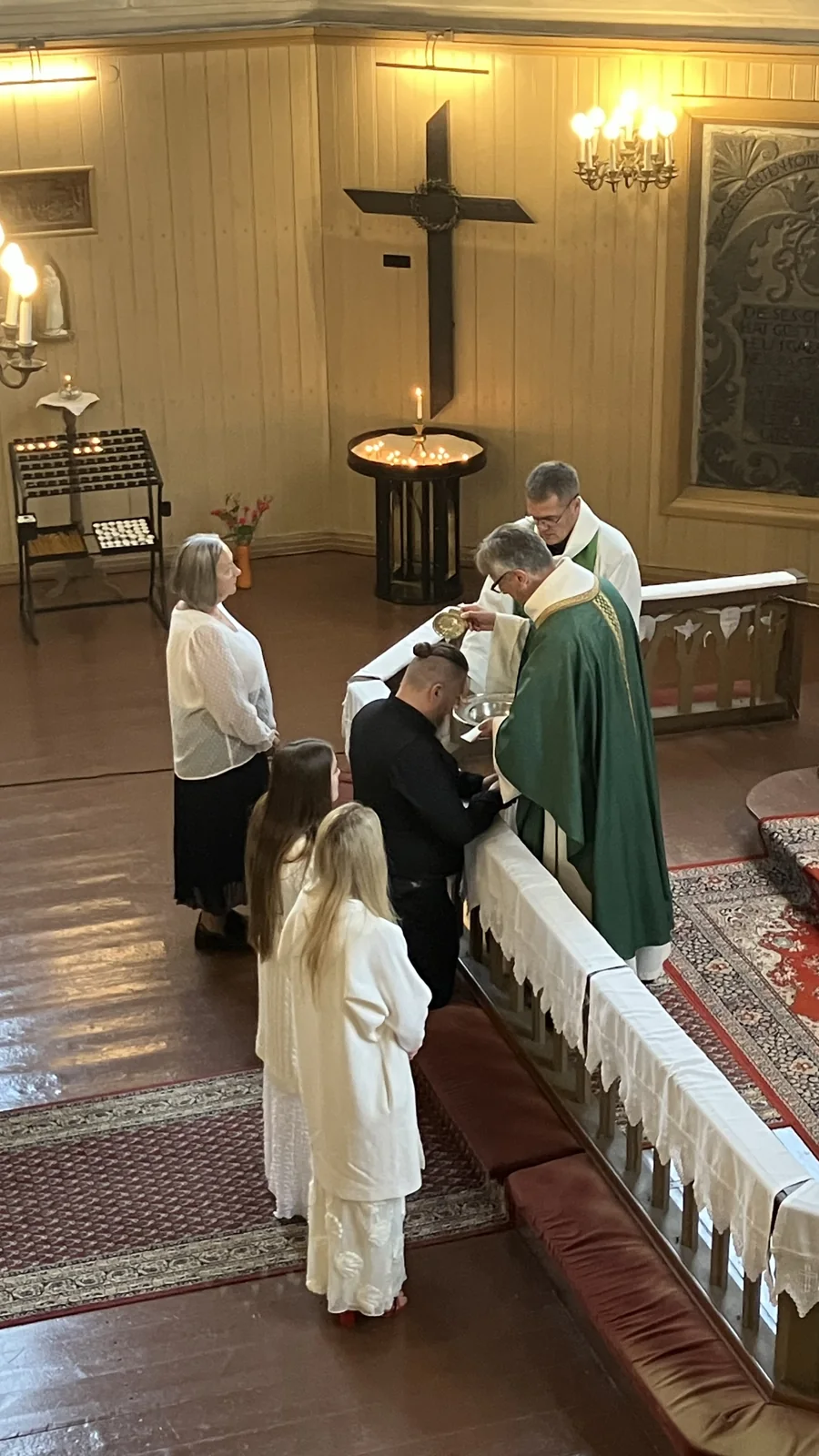
The minister pours water three times over the person’s head and says: “[Name], I baptise you in the name of the Father and of the Son and of the Holy Spirit.” In the full rite, other blessings and prayers are included in their appointed order. Baptism is normally administered by a minister of the local parish.
In danger of death, if a minister cannot be called in time, any person may validly baptise—but only in a true emergency. The person baptising must intend to do what the Church does in Baptism. If possible, at least one witness should be present. An emergency Baptism is confirmed in church at the first opportunity.
For Baptism to be valid, both the person baptising and the person receiving Baptism—or the sponsor in the case of an infant—must intend Baptism. Clean water and the proper formula must be used. Enough water must be used for it to flow; a single drop touching only the hair is not sufficient.
A child should be baptised as soon as reasonably possible after birth. An adult should be baptised once they have been instructed in the basic truths of the Christian faith.
What does Baptism require of us?
Baptism calls us to avoid sin and occasions of sin, to live a life pleasing to God, and to hold to the teaching of the Church.
An event for a lifetime
It is never too late to be baptised. Parents sometimes ask to have their child baptised without yet having considered Baptism for themselves. Jesus says: “No one can enter the kingdom of God without being born of water and Spirit.” (John 3:5). A person’s belief or unbelief, preconceptions or lack of knowledge do not diminish the importance of Baptism.
A person is baptised only once. Even if a baptised person later chooses not to live as a Christian, the Baptism cannot be undone, because the sacrament is Christ’s own act.
Who are godparents?
Godparents support the person being baptised as spiritual parents. At an infant Baptism they confess the faith and make the baptismal promises on the child’s behalf. They must be practising members of the Church—baptised, confirmed and admitted to Holy Communion. Their duty is to help teach and raise the baptised person in the Christian faith, which is why someone who is not a church member cannot serve as a godparent. At least one godparent is required; where possible there should be two, a godfather and a godmother.
A young person or adult may also choose godparents, although this is not compulsory. Even someone able to decide for themselves to be baptised can benefit greatly from a faithful godparent.
Young people and adults receive instruction in the foundations of the Christian faith before Baptism. This normally takes the form of a confirmation course, followed by confirmation after Baptism.
What might a godparent give as a baptismal gift?
A suitable gift is a cross necklace that can still be worn in adulthood, perhaps engraved with the date of Baptism. A book of Bible stories is appropriate for a younger child, and a Bible for an older child, young person or adult.
What is conditional Baptism?
If there is doubt whether a person has already been baptised, or whether they are able validly to receive Baptism, a conditional Baptism is administered. A condition is added to the formula, such as “If you are not baptised …” or “If you are still alive …”. This avoids the sacrilege of baptising the same person twice or baptising someone who has died.
What should I do if I wish to be baptised or have my child baptised?
It is natural for a newborn child to be baptised as soon as possible, preferably during the first months of life. A child is baptised at the request of parents who intend and promise to raise the child as a Christian. At least one parent or guardian must therefore be a practising church member—baptised, confirmed and admitted to Holy Communion.
The time and place are agreed with the pastor, who can also answer any other questions.
Baptism normally takes place in church, or exceptionally at home, in hospital or elsewhere. A baptismal vessel with clean water is prepared. The person being baptised traditionally wears white: the colour of purity and joy. A long white robe symbolises the new life given by Christ; a baptismal gown is suitable for a baby.
Relatives and friends may be invited to share this great day and congratulate the family. A festive meal may follow at home or in the parish rooms.
For an adult or teenager, Baptism is normally accompanied by confirmation instruction and by confirmation, through which the person becomes a full member of the parish.
See also
- A Godparent’s Guide
- Life as a Member of the Congregation
- Small Catechism: Baptism (in Estonian, on the EELC website)