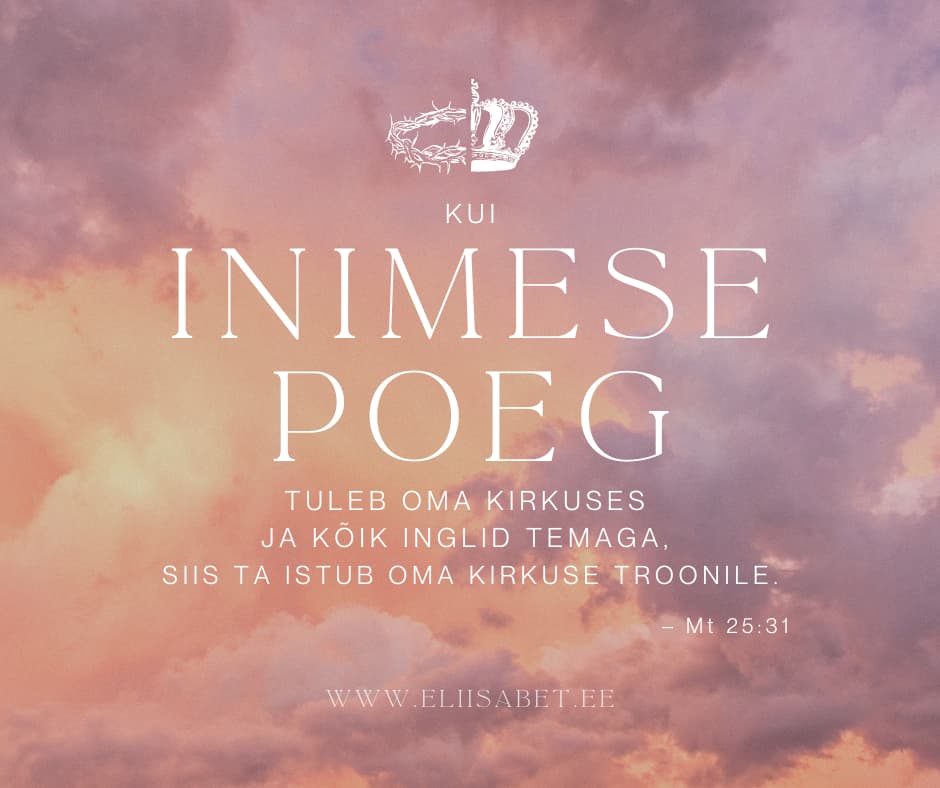
Jesus says: “When the Son of Man comes in his glory, and all the angels with him, then he will sit on the throne of his glory. All the nations will be gathered before him, and he will separate people one from another as a shepherd separates the sheep from the goats.” Matthew 25:31–32
When we remember the departed, we cannot avoid asking what eternity awaits them and us after temporal death, and what kind of King this Christ is who will come at the end of time to judge the living and the dead.
These are not especially popular subjects. Today death is pushed out of real life and into the virtual realm, where it is presented as a distorted and seemingly harmless image. This happens not only in films, but particularly in computer games, where “losing a life” is not a very serious matter.
People nowadays are fond of speaking about all manner of phobias. Two kinds of fear are very widespread: fear of life and fear of death. It is paradoxical how many people take their own lives because they fear death. Death has been banished from modern culture. In the Western world it is such an unpleasant and indecent subject that people would sooner speak about pornography. The dying are sent away to care homes and specialist hospitals, out of sight. When death and old age become taboo, the image of the mature adult in the prime of life and strength also disappears. Youth and childishness are honoured and elevated almost to divinity. People are ashamed to be old and venerable. This is the way of thinking of a world that does not believe in eternal life.
Yet in reality we cannot escape thinking about death. Somewhere, often at a most unexpected moment, this subject awaits everyone; and anyone unprepared to meet it truly has reason to fear death.
For Christians, however, death is a familiar subject. We have thought about it. We know why it exists here in a world bound to decay after the Fall, and where it leads. For us it is like the end of a book—and an endless book would be dreadful. In the Bible, immortality was given to Cain as a curse. In Christian tradition he is spoken of as the “Wandering Jew”, for whom immortality is a punishment. He longs for death, yet cannot die.
Death was given to fallen humanity so that our time of trial within limited space and time—living in a territory separated from God and ruled by the tempter—would not continue without end. With death our time of trial concludes, and the choices we made here are finally revealed.
In a familiar joke, twins in their mother’s womb wonder: “Do you think there is anything on the other side?”—“I don’t know, but no one has ever come back.” We have an advantage over them, for the Creator of time and eternity has himself told us something about what awaits beyond this narrow realm of space and time. Jesus Christ, our Saviour, has even returned from death and offers us eternal and true Life in himself.
We are not yet in eternity, but we can catch a glimpse of it if we spend as much time as possible in quiet contemplation. (Richard Wurmbrand)
Archbishop Urmas Viilma has observed that focusing too much on our worries keeps us bound to earthly life, which is nothing other than dwelling amid what passes away. We need not grasp after this life and cling to it, but should thirst for eternity.
An enduring dilemma lies before us, for we are citizens of two kingdoms. We live at once in transience and in eternity: in the temporal world between our birth and death, while at the same time, as Christ’s disciples, Jesus’ messengers and children of his eternal kingdom, we may already receive a foretaste of eternal life.
Living merely for the sake of living—even as comfortably or pleasurably as possible—is in truth to lose one’s life. Life must be given content and meaning that carry no “best before” date. The purpose of every Christian’s meaningful life is to live in Christ and become ever more like him. This means loving God and all that he has created ever more perfectly.
And so we return to today’s Gospel reading and the Last Judgement. Dies irae, dies illa—it is a dreadful day of wrath for all who find themselves among the goats.
Who among us can say with certainty that we are righteous? The one who believes in Jesus as Saviour and Redeemer. The one who desires and strives to love as the Lord Jesus has taught us to love, yet also knows that whatever is lacking in human ability is made good by the blood of Jesus shed on the cross at Calvary for our redemption. United with him, his righteousness becomes ours—the righteousness of him who perfectly feeds all who hunger, clothes the naked, and visits the sick and those in prison.
Come and meet Jesus now, so that you may also be his friend on the Last Day! Holy Mass begins at St Elizabeth’s Church at 10 am.